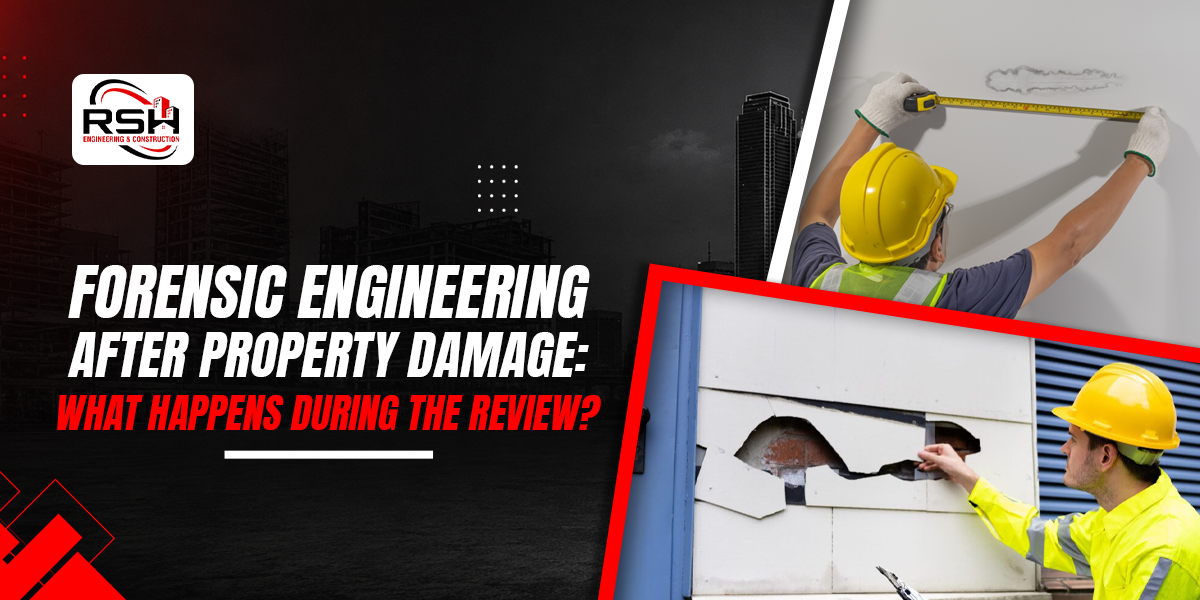
Property damage is one of the most stressful news items for all property owners, insurers, collectors, and legal teams. Various questions arise, such as what causes the damage, to what extent the property is damaged, and the possible loss. This is why we need forensic engineering after property damage, which helps in identifying the cause, possible culprits, and damage using professional analysis.
RSH Engineering & Construction helps in understanding how forensic engineering works and providing trusted services.
Understanding What Forensic Engineering Review Is
Property damage often includes different aspects that should be clearly looked at and noted down. It can be understood as a detailed forensic engineering inspection to understand why this damage occurred. This is a professional way to assess the building conditions, visible damages, the construction site, and supporting evidence.
With the help of this inspection, you can properly make repair decisions, legal decisions, insurance claims, and property planning.
Important Steps Involved in Forensic Engineering Inspection
These engineering inspection services often involve different steps that help the engineers prepare a detailed and technical evaluation report. Let’s check each of them:
1. Case Review: Initial
This is the first and foremost step when any property owner contacts forensic structural engineering, in which they initially review their concern. It covers some of the points like what happened, when it was first seen, and what the primary areas are that are affected.
Engineers may ask for damage proof like clear photos, repair history, earlier reports, construction plans, or previous evaluations.
2. Inspection of Site
This phase is one of the important steps in which the engineers visit the site for proper inspection of the damaged areas. This is also known as the foundation inspection, in which they look for visible signs such as cracks, settlement, framing movement, water intrusion, building material, structural displacement, roof alignment, drainage problems, and more.
Here they collect photos, measurements, notes, and observations to document the condition of the property.
3. Documenting the Facts
Documenting is an important part of this review, and once they complete their evaluation, they record where damage is located, how it appears, and the possibilities of patterns that may point to a specific cause.
Forensic engineering for insurance claims and the contractor’s perspective helps a lot. It includes documenting damages like foundation damage, wall separation, or a sloped floor, which all tell a different story.
4. Analyze the Cause and Origin
After all these steps, engineers look for the main cause of this damage and when it started. They use different tools and scientific concepts to exactly determine what actually caused the damage. Generally, it involves a review of structural behavior, drainage problems, weather conditions, soil movement, material-related issues, or damage related to impact.
In this way, engineers can clearly find the reason for the damage.
5. Engineering Evaluation
This structural engineering inspection also includes the decision on whether the damage will affect safety, performance, or long-term property use or not. Some issues can be cosmetic, but some also require repair work or further investigation. This will help the owners to know the seriousness of the issues.
6. Written Engineering Report
After all evaluation work, the final step is to prepare a detailed report that will help in insurance claims, repairs, contractor purposes, or legal work whenever it is needed.
This report consists of different things like the findings of the inspection, photos, videos, observations, analysis, conclusion, and what should be the professional recommendations.
Importance of Forensic Engineering After Property Damage
A forensic engineer for property damage is the most important aspect, which helps you to make an informed decision based on a strong technical foundation. It supports you with answering these questions:
- What are the possible damages caused?
- Is the damage sudden or long-term?
- What repair do you need?
- Is the structure safe?
- Should we go for more investigation?
The engineer’s findings really help the owners, insurers, and contractors in case repair is needed.
Conclusion
Forensic engineering after property damage is the most important step that every owner takes. It helps the owners, insurers, and contractors in different ways, like knowing safety issues, insurance claims, repair work, and dealing with legal cases. There are different necessary steps that every forensic engineer follows to provide all detailed reports. RSH Engineering & Construction is a trusted forensic engineering services provider that helps homeowners and property owners.
Frequently Asked Questions on Forensic Engineering After Property Damage: What Happens During the Review?
Q1. What exactly happens during a forensic engineering review?
A1. Engineers inspect the damage site, find the cause of damage, prepare reports, and give future assumptions.
Q2. How long does a forensic engineering inspection take?
A2. Generally, it depends on the type of damage and its site. If the damage is severe and the site is large, it may take 4 to 8 weeks.
Q3. What should I expect when a forensic engineer visits my home?
A3. When a forensic engineer visits your property, he will find the cause of damage and possible future actions.